

Blog Post #2: Databases Vs Search Engines
- Jan 4, 2018
- 2 min read
As we grow older and advance in school, we use the internet more and more. It's important for us to know how to use the internet safely and efficiently. For example, a very popular website that students like to use is Wikipedia. Wikipedia is an online encyclopedia that has information on practically everything. However, even though Wikipedia gives information for free, it is also possible for unqualified people to edit and create information on Wikipedia. This make the information on Wikipedia unreliable. I think that Wikipedia is not a good site to base your entire research. However, I think Wikipedia is a good starting place for your research. Let's say you are researching about Malala Yousafzai. Instead of going to her Wikipedia page and basing your research off that, you can scroll down and look at the sources that were used.
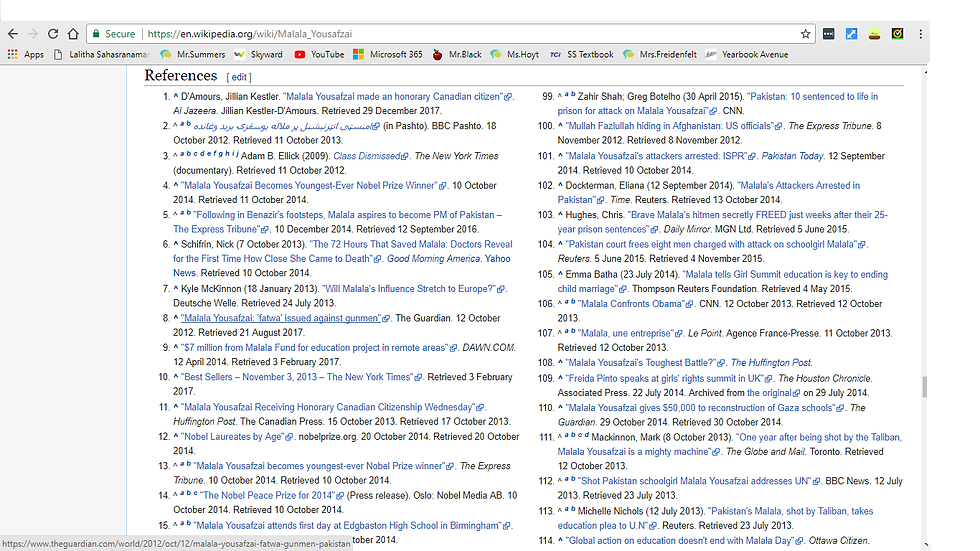
From there, you can choose a source that you can use for information. Another use for Wikipedia is if you need quick facts. Some examples are name, spelling, birth dates, nationality, location, images, and/or quick bio about the person or place.
Even though Wikipedia is a good way to get information quickly, it isn't reliable. Because of this, many students will use search engines such as Google or Yahoo to take them to other websites with the information they need. This however isn't the best option. Let me explain why. Search engines are designed to organize information and websites based on the keywords you use when you search for something. If you search up "dogs", you will get 604,000,000 results. In these results, you will get websites regarding pet stores, dog schools, dog breeds, images of dogs, dog trainers, dog sitters, movies about dogs, and much more. This isn't very helpful if you just want to write a paper about the labradoodle. Even if you narrow your search words, the websites you get aren't reliable as well. If you end up getting information off a random person's blog, the information isn't as credible. You don't know that this person is qualified enough to give accurate information about a topic. You also don't know if that person is an actual profesional or if they are just a random person who does this in their free time. Search engines aren't as reliable as databases. Databases are sets of data that can be easily accessed. Not only are databases easy to be accessed, they are also reliable. Professionals on the subject look over the information in the database to make sure it is reliable.
Three databases that I am thinking of using:
1. Opposing viewpoints in Context - I think that this site will give me a lot of useful information , especially about the history of photography.
2. Access Video - I often learn at a faster rate when given a visual or video. I think this feature of me comes from my habit to draw diagrams to explain procedures, math equations, science theories, and much more
3. ProQuest - This is just a backup, but I do think I will get insightful information in this site if it can not be found in Opposing Viewpoints in context.
Comments